

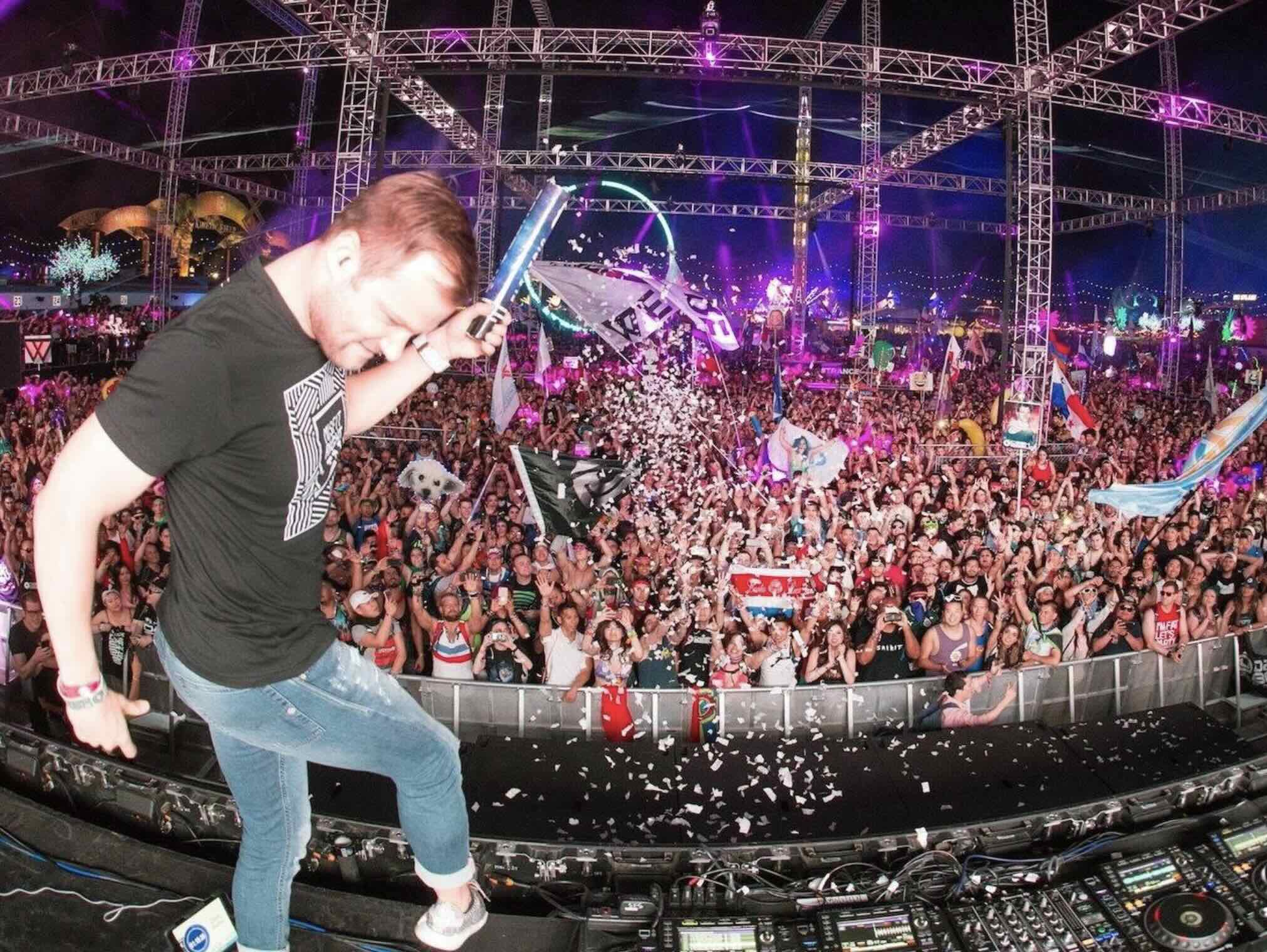
Parookaville once again brought together some of the biggest names in electronic music, creating an atmosphere where artists and fans could come together to celebrate the culture, energy and evolution of dance music. Among the artists making an impression this year was Dutch DJ and producer Jeffrey Sutorius, who delivered his first performance at the festival under his own name.
Known globally for his journey as part of Dash Berlin, Sutorius has spent years performing on some of the world’s biggest stages and building a deep connection with electronic music audiences. We got chance to sit down with him in person right after his set at Parookaville 2026.
How are you today? How has your experience at Parookaville been so far?
I’m very happy, just come off the stage and this is my first time at Parookaville. I don’t do a lot of shows in Europe, so I’m really enjoying the festival and the overall experience. I’m here as an artist, of course, but I’m also trying to experience the festival a little bit like a visitor. It’s been a great experience so far.
Your father and sister were also connected to the music industry. Did they influence your journey into music or help shape your career?
They didn’t necessarily give me specific help with my career, but they definitely connected me to music from a very young age. My father was a jazz drummer, and when I was about eight years old, he and my mother gave me a drum kit for my birthday. That introduced me to rhythm and gave me my first real connection with making music. I taught myself how to play the drums.
Then there was my sister who was a dancer and performer in clubs when I was growing up. At that time, DJs used to sell cassette tapes for around 25 guilders to promote their music and give people a taste of what was being played in the clubs.
My sister would bring those tapes home, and I started listening to them. That really got me hooked on electronic dance music and sparked my interest in the culture.
How did the name Dash Berlin come about?
It was a little bit of a two-part story. We wanted a name that connected with Berlin because the Love Parade originated there. People from all over the world would come to Berlin to experience the parade of trucks playing electronic dance music. I experienced the Love Parade myself in 1999 and 2000, and I actually performed there under different aliases before Dash Berlin existed.
When we started experimenting with combinations of words, we came up with “Dash Berlin.” At the time, when we typed “Dash Berlin” into Google, there was practically nothing there a blank page. We thought that was actually very fitting. It felt like starting with a blank canvas and having the opportunity to build something completely from scratch.
When you look back at Dash Berlin journey, how do you feel about it today?
Dash Berlin has a very long history and an incredible development in terms of fan engagement, music and shows around the world. There’s been a lot of fantastic history associated with Dash Berlin, and I’m very proud of it. When I look back at everything connected to Dash Berlin, I look at it in a very positive way and appreciate everything that happened along the journey.
This is your first time at Parookaville. How did you feel about performing here as Jeffrey Sutorius?
I’m very happy with how the show went today. It was my first encounter with the German crowd at Parookaville as Jeffrey Sutorius, and it was a really nice first experience. I could definitely see that people were connecting with the music I was playing.
I also played some exclusive Jeffrey Sutorius music that will be released over the coming months. So I think this is a great beginning for Jeffrey Sutorius at Parookaville and in Europe.
There’s currently Techno wave around the world. What do you think could be the next big wave in electronic music?
You’re right, music comes and goes in waves.
If you look at the bigger picture of what’s happening in the world right now, there’s a lot of difficulty and uncertainty. People have a lot of energy that they want to release, so I understand why this raw and harder sound has become so popular.
But after every raw, harder phase, there’s always room for melody and vocals to come back into the picture. I think we’re already starting to see that transition. Hard techno is increasingly being influenced by trance, creating techno-trance or trance-techno crossovers in production. You’re also hearing DJs play those sounds in their sets.
Eventually, I think we may see a stronger shift toward more melodic and vocal-driven music. Hopefully, if the world becomes a little calmer and we move into more peaceful waters, the music will reflect that as well.
Do you know any Indian artists or traditional Indian musical instruments?
I’ve received tracks from India and from Indian fans over the years, and I know there’s definitely a lot of talent coming out of India. It’s a huge country, and I know electronic dance music is very popular there. I think it’s only a matter of time before the next big Indian superstar in electronic dance music steps onto the global stage.
Follow Me